
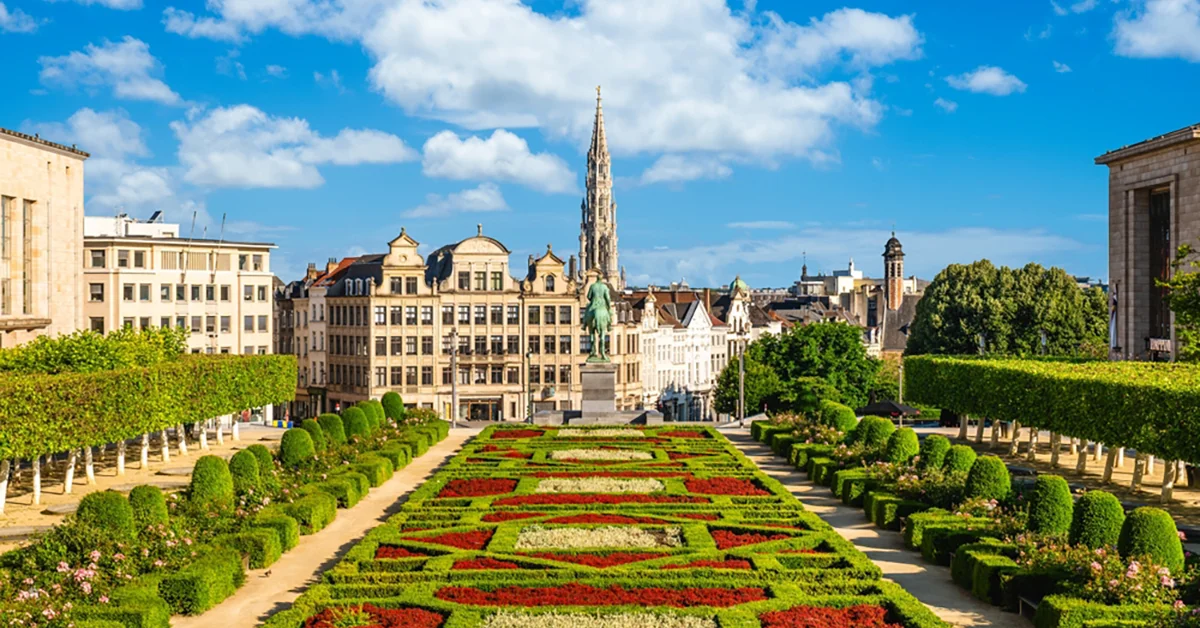
Belgium and artistic mastery share a legacy that has shaped Western civilization for more than six hundred years. This compact nation at the heart of Europe has produced an extraordinary concentration of artistic talent—from the revolutionary oil painting techniques of the Flemish Primitives to the surrealist visions of René Magritte, from medieval Gothic cathedrals to the sinuous curves of Art Nouveau townhouses. To walk through Brussels, Bruges, Ghent, or Antwerp is to traverse a living gallery where architectural marvels and artistic treasures await around every cobblestoned corner.
Belgium’s creative heritage extends far beyond museum walls. The nation’s cities themselves function as open-air exhibitions, where centuries of architectural experimentation have produced streetscapes unlike anywhere else on Earth. Gothic spires pierce gray skies above guild houses adorned with gilded facades, while elegant Art Nouveau doorways frame entrances to buildings that seem to breathe with organic life. For travelers seeking authentic encounters with European cultural heritage, Belgium offers rewards that rival its larger neighbors while maintaining an intimacy that makes genuine discovery possible.
The Golden Age of Flemish Painting
The story of Belgian art begins in earnest during the fifteenth century when Flemish painters revolutionized European visual culture. Jan van Eyck, working in Bruges and Ghent, perfected oil painting techniques that allowed for unprecedented detail, luminosity, and depth. His Ghent Altarpiece, completed in 1432 and displayed in Saint Bavo’s Cathedral, remains one of the most influential artworks ever created—a monumental polyptych whose panels reveal scenes of such crystalline clarity that viewers continue to discover new details five centuries later.
Van Eyck worked alongside other masters who collectively became known as the Flemish Primitives, though their techniques were anything but primitive. Rogier van der Weyden brought emotional intensity to religious subjects, Hans Memling created portraits of startling psychological depth, and Hugo van der Goes produced altarpieces that influenced Italian Renaissance masters including Leonardo da Vinci. These artists established workshops that attracted patrons from across Europe, transforming cities like Bruges into cultural capitals that rivaled Florence and Venice.
The wealth generated by Flanders’ textile trade and strategic trading position funded this artistic flowering. Merchant families commissioned portraits that demonstrated their prosperity and piety, while churches competed to display increasingly magnificent altarpieces. The marriage of commercial success and artistic ambition created conditions that would define Belgian creative culture for centuries—a tradition of patronage and craftsmanship that persists today.
Baroque Splendor and Rubens’ Legacy
The seventeenth century brought Peter Paul Rubens to Antwerp, where he established a workshop that dominated European art for decades. Rubens combined Italian influences absorbed during extensive travels with distinctly Flemish sensibilities, creating dynamic compositions filled with movement, flesh, and drama. His enormous canvases depicting mythological scenes, religious subjects, and aristocratic portraits hung in palaces from Madrid to Munich.
Rubens transformed Antwerp into a cultural powerhouse during the Spanish Netherlands period. His workshop trained numerous artists who carried his influence throughout Europe, while his diplomatic missions brought him into contact with kings and cardinals who became enthusiastic patrons. The Rubenshuis, his former home and studio, survives today as a museum that reveals both his artistic process and his taste for luxurious living.
Anthony van Dyck, Rubens’ most talented pupil, developed portrait techniques that influenced English painting for two centuries after he became court painter to Charles I. Jacob Jordaens continued the Baroque tradition with earthy genre scenes and mythological compositions, while countless lesser masters contributed to an artistic ecosystem that made Antwerp one of Europe’s most productive creative centers.
Architectural Heritage Across the Centuries
Belgian architecture presents a remarkable palimpsest of styles spanning nearly a millennium of construction. Romanesque churches from the eleventh and twelfth centuries survive in cities like Tournai, whose cathedral features five towers that create an unforgettable silhouette. The transition to Gothic architecture produced masterpieces including the cathedrals of Brussels, Antwerp, and Mechelen—soaring structures whose towers reach toward heaven while their interiors bathe worshippers in colored light filtered through vast stained glass windows.
The Grand Place in Brussels represents perhaps the finest surviving example of medieval guild architecture anywhere in Europe. Following French bombardment in 1695, the city’s guilds rebuilt their headquarters with competitive magnificence, creating an enclosed square of gilded facades, ornate gables, and sculptural programs that tell stories of civic pride and commercial success. UNESCO designated the Grand Place a World Heritage Site in 1998, recognizing its exceptional preservation and architectural coherence.
| Architectural Period | Key Characteristics | Notable Belgian Examples |
| Romanesque (1000-1200) | Rounded arches, thick walls, sturdy columns | Tournai Cathedral, Saint Bartholomew’s Church (Liège) |
| Gothic (1200-1500) | Pointed arches, flying buttresses, large windows | Cathedral of Our Lady (Antwerp), Saint Bavo’s Cathedral (Ghent) |
| Renaissance/Baroque (1500-1700) | Classical elements, ornate decoration, symmetry | Grand Place guild houses (Brussels), Rubenshuis (Antwerp) |
| Art Nouveau (1890-1910) | Organic forms, ironwork, integrated design | Horta Museum, Hotel Tassel, Old England Building (Brussels) |
| Art Deco (1920-1940) | Geometric patterns, luxurious materials, bold colors | Basilica of the Sacred Heart (Brussels), Résidence Palace |
The Belfry tradition, unique to Belgium and neighboring regions, produced towers that served as symbols of civic independence and commercial prosperity. These structures housed bells that regulated daily life, called citizens to meetings, and warned of dangers. Bruges, Ghent, and numerous smaller towns preserve magnificent belfries that dominate their medieval skylines.
Art Nouveau: Brussels’ Revolutionary Contribution
No city embraced Art Nouveau more completely than Brussels during the final decade of the nineteenth century and the first years of the twentieth. Victor Horta, the movement’s principal architect, designed buildings that rejected historical pastiche in favor of organic forms inspired by natural growth patterns. His Hotel Tassel, completed in 1894, is generally considered the first true Art Nouveau building—a revolutionary structure where iron, glass, and stone flow together in sinuous curves that seem almost alive.
Horta’s subsequent commissions refined and expanded his vision. The Hotel Solvay, designed for an industrial magnate, features interiors where every element—from door handles to light fixtures to mosaic floors—participates in a unified aesthetic program. His own home and studio, now the Horta Museum, allows visitors to experience Art Nouveau as a total environment rather than merely a collection of decorative objects.
Other architects contributed to Brussels’ Art Nouveau heritage. Paul Hankar developed a more geometric variant of the style, while Gustave Strauven created exuberant facades decorated with ironwork of extraordinary intricacy. The Saint-Gilles and Ixelles neighborhoods preserve entire streets of Art Nouveau townhouses, offering visitors opportunities to discover architectural treasures simply by wandering with attentive eyes.
Surrealism and Modern Masters
Belgian art took another revolutionary turn during the twentieth century when René Magritte developed his distinctive brand of surrealism in Brussels. Unlike the dreamlike automatism of other surrealists, Magritte painted with precise realism—then subverted expectations through impossible juxtapositions and visual paradoxes. His bowler-hatted men, mysterious floating objects, and paintings-within-paintings continue to challenge viewers’ assumptions about representation and reality.
The Magritte Museum in Brussels, housed in a neoclassical building on the Place Royale, contains the world’s largest collection of his work. Nearby, the Musée d’Art Ancien and Musée d’Art Moderne (collectively the Royal Museums of Fine Arts) present Belgian art from the Flemish Primitives through contemporary practitioners, offering comprehensive surveys of the nation’s creative evolution.
Other twentieth-century Belgian artists achieved international recognition:
- James Ensor pioneered expressionism with carnival masks and skeletal imagery that influenced generations of artists
- Paul Delvaux created dreamlike scenes of classical architecture populated by enigmatic female figures
- Marcel Broodthaers challenged artistic conventions through conceptual works that questioned institutions and language
- Luc Tuymans continues Belgium’s tradition of painterly innovation with haunting canvases that address history and memory
Planning Your Belgian Art Journey
Belgium’s compact geography makes ambitious cultural itineraries entirely feasible. High-speed trains connect Brussels to Bruges in under an hour, while Ghent and Antwerp require similarly brief journeys. Most major museums cluster in city centers accessible on foot, and the tradition of pedestrian-friendly urban planning means that architectural discoveries reward those willing to explore beyond obvious destinations.
Weekday mornings generally offer the most contemplative museum experiences, particularly at popular sites like the Magritte Museum or Ghent’s Saint Bavo’s Cathedral. Many churches housing significant artworks maintain limited visiting hours during religious services, so consulting schedules before arrival prevents disappointment. The Museum Pass Brussels provides economical access to numerous institutions for visitors planning extended cultural exploration.
Staying Connected in Belgium: World Mobile eSIM
While immersing yourself in Belgium’s artistic treasures, reliable connectivity enhances every aspect of your journey—from navigating medieval streetscapes to researching opening hours and sharing discoveries with friends and family. World Mobile offers convenient eSIM plans for Belgium that eliminate roaming charges and the inconvenience of purchasing local SIM cards.
The World Mobile Belgium eSIM provides:
- Unlimited high-speed 5G/4G data throughout Belgium
- Flexible plan options: 3 days ($9.90), 7 days ($19.90), 14 days ($29.90), or 21 days ($39.90)
- 20 international calling minutes included
- Coverage across 120+ destinations
- Unlimited Data Coverage in 80+ Destinations
- Plan auto-starts only when you land in Belgium
Installation requires simply scanning a QR code sent via email—no physical SIM card or shop visit necessary. With 24/7 multilingual support,World Mobile ensures seamless connectivity for your Belgian adventure. Visitour Belgium Esim Plan page to select your plan before departure.
A Living Canvas
Belgium’s artistic heritage represents far more than museum collections and architectural monuments. It embodies a cultural philosophy that values craftsmanship, innovation, and beauty in daily life—qualities evident in everything from hand-finished chocolates to carefully restored guild houses. The nation’s relatively small size belies an artistic density that rewards sustained attention, offering discoveries that larger countries cannot match.
For travelers willing to look closely and move slowly, Belgium reveals itself as one of Europe’s most rewarding cultural destinations. Stand before the Ghent Altarpiece as morning light illuminates its panels, wander through Art Nouveau neighborhoods as afternoon shadows emphasize ornate ironwork, and watch the Grand Place transform as evening illumination gilds its ancient facades. In Belgium, six centuries of artistic ambition await those who arrive with curious eyes and unhurried spirits.


